A quotation offering a choice between FUE and DHI can be confusing. FUE describes how follicular units are obtained from the donor area; DHI is a label used for certain implantation workflows. A procedure advertised as DHI may therefore still use FUE to harvest its grafts. Before comparing prices or choosing a technique, ask the clinic to describe harvesting and placement separately. This article explains that terminology, rather than ranking instruments or predicting which option will give an individual patient the best result.
One operation, different stages
Hair transplantation has both a donor stage and a recipient stage. In FUE, individual follicular units are removed with small circular punches. Those grafts are then placed in the area being treated. The ISHRS distinguishes donor harvesting from implantation and explains that grafts can be placed using forceps or implanters. Changing the placement tool does not, by itself, change the method used to obtain the grafts.
For example, a written plan can say that grafts will be harvested by FUE and placed using an implanter. Both descriptions can be accurate. A useful quotation identifies the steps in ordinary language, so you can compare what will actually happen rather than assume that two promotional labels describe entirely different operations. Our FUE guide covers the broader procedure; this page focuses on the relationship between harvesting and placement.
Sources: [1]
An implanter does not always mean the same workflow
The ISHRS describes two broad implanter approaches: a dull device places a graft into a previously made recipient incision, while a sharp device can create the incision and place the graft in the same action. It also notes that practitioners use DHI for different workflows, including implantation shortly after harvesting. That variation makes it important to ask what a clinic means by the term.
Using a pen-shaped instrument is not proof that recipient incisions were avoided. Ask whether sites are made beforehand or during placement, and who performs that part of the surgery. You do not need to choose the surgical instrument yourself; you need an understandable explanation of the proposed procedure and the clinician's reasons for recommending it.
A concrete example: K.E.E.P. and premade recipient sites
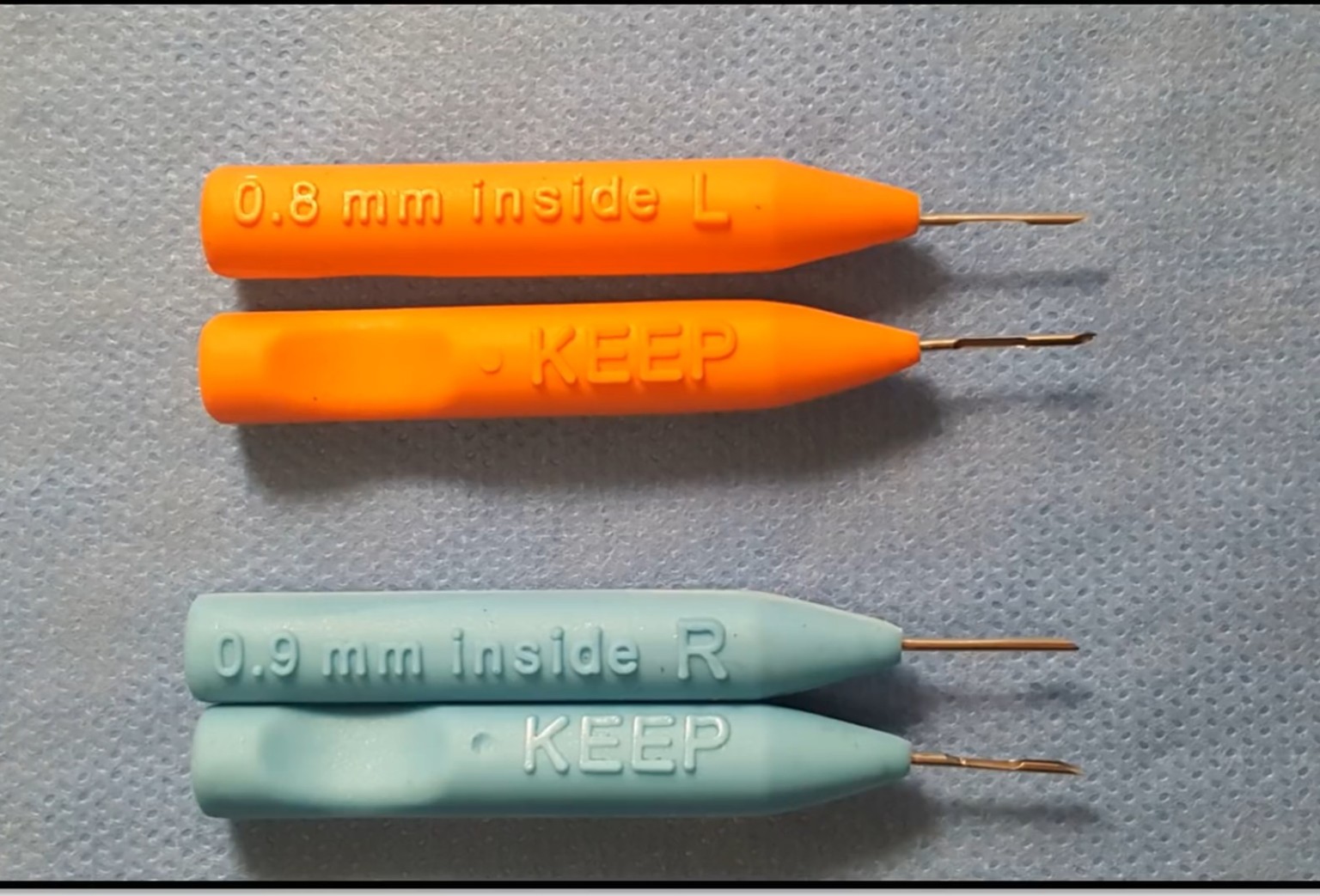
K.E.E.P. stands for Koray Erdogan Embedding Placer. ASMED's official product page describes it as a graft-placement instrument designed for use with premade recipient incisions. This makes it a concrete example of why donor harvesting and implantation should be described separately: the placer is used at the recipient stage and does not itself describe how the grafts were harvested.
According to ASMED, the instrument is made from medical steel, is available in different sizes and left- or right-hand configurations, and can undergo normal sterilization processes. These are the clinic's descriptions of its device. Its stated aim of reducing graft handling should not be read as an independently established guarantee of better growth. The 2019 implanter report discussed below is not evidence specific to K.E.E.P., and it cannot validate claims for this particular instrument.
Sources: [5]
What the published research can and cannot establish
A 2019 report in the Journal of Cutaneous and Aesthetic Surgery described using implanters in premade recipient sites during FUE in 104 patients, of whom 103 were men. It demonstrates that these approaches can be combined in a clinical workflow. The authors explicitly reported that they did not objectively measure hair regrowth. The study described a treated series, not a randomized comparison assigning patients to competing placement methods.
Accordingly, that paper should not be used to promise a particular graft-survival percentage or to claim that every implanter-based procedure produces better results than forceps placement. It is an older technique report, not a new 2026 breakthrough. When a clinic cites research, check whether it studied the same instrument and workflow being offered, and whether its outcome measurements actually support the advertised claim.
Sources: [2]
Placement labels do not remove surgical responsibility
The ISHRS position statement, revised on 13 July 2024, treats skin incisions for donor harvesting or recipient-site preparation as surgery. It calls for properly trained, licensed physicians and recognizes specific legal delegation arrangements for accredited professionals in some countries. A professional position statement does not replace the rules applicable where treatment takes place. Ask for the named responsible clinician and a clear account of each person's role.
The NHS describes infection, bleeding, noticeable scarring and unsuccessful graft growth among possible complications of hair transplantation. A DHI label does not establish that those risks disappear. The consultation should address your clinical suitability, the limits of the proposed plan and arrangements for follow-up, alongside any explanation of the instrument.
How to compare two proposals in practice
Ask each clinic to fill in the same short description: donor harvesting method, recipient-site creation, graft-placement tool, and responsible professionals. If an answer only repeats the package name, request more detail. Then ask why that workflow was selected for the area you want treated. Keep the written explanation with your quotation so that any later change in the plan can be discussed before surgery.
This comparison is a way to organize a consultation, not a scoring system for surgical quality. A proposal that explains its steps gives you more concrete questions to discuss. For the separate issue of verifying credentials and follow-up responsibility, use our surgeon-selection guide. For how much donor hair can appropriately be used, consult the donor-area guide rather than infer capacity from a DHI or FUE label.
- How will my grafts be harvested?
- Are recipient sites made before placement or by the placement instrument?
- Who makes each incision, and who loads and places the grafts?
- Which evidence supports the specific benefit being claimed for this workflow?
Common questions
Can DHI and FUE be used in the same procedure?
Yes. Grafts may be harvested by FUE and placed using a workflow described as DHI. Ask the clinic to specify both stages.
Does DHI mean a procedure without incisions?
No. Sharp implanters can create a skin incision while placing a graft; other implanters place grafts into premade sites. The clinic should explain its exact approach.
Does the 2019 study prove implanters are better for everyone?
No. It reported a specific clinical series and acknowledged that objective hair-regrowth assessment was not performed. It does not establish universal superiority.
This article provides general information, not diagnosis or individual medical advice. This website is affiliated with ASMED Surgical Medical Center; ASMED consultation links are commercial. Unless otherwise stated, this article has not undergone individual clinician review. Discuss medical choices with a qualified physician.
References and further reading
- A Guide to Hair Transplant Surgery — donor harvesting and implantation methods (accessed 2 October 2026; no revision date displayed) — ISHRS
- Use of Implanters in Premade Recipient Sites for Hair Transplantation — 2019;12(4):250–254; DOI 10.4103/JCAS.JCAS_33_19 — Journal of Cutaneous and Aesthetic Surgery
- Position Statement on Qualifications for Scalp Surgery — revised 13 July 2024 — ISHRS
- Hair transplant — last reviewed 29 September 2023; listed next review due 29 September 2026 (accessed 2 October 2026) — NHS
- K.E.E.P. (Koray Erdogan Embedding Placer) — official device description; accessed 2 October 2026; no publication date displayed; clinic source, not independent comparative evidence — ASMED Surgical Medical Center